The short answer
Is a Chrome extension a business? Yes, when it does a job people repeat, charges for something a copy can't take, and doesn't depend on one platform changing its mind. Otherwise it's a feature, often one a bigger product will add for free. Four quick tests tell you which one you've built.
- Features get absorbed. Businesses own a repeated job.
- Ask whether the paid part needs your server.
- Check if a giant could ship your tool as a checkbox.
- Most live extensions are tiny: the median in our crawl has 857 users (2 Oct 2026).
A good spoon is useful. Nobody builds a company around a spoon, unless it's attached to a restaurant.
Lots of extensions are spoons. Handy, loved, and one browser update away from being built in.
So, is a Chrome extension a business, or a feature? Four tests decide it.
Test 1: does it own a repeated job?
Momentum opens in every new tab. Grammarly fires every time you type. Those tools earn because the job comes back dozens of times a day.
A one-off converter you use twice a year is a feature. Lovely, and hard to charge for. Our guide to making money with Chrome extensions shows how to check who pays.
Test 2: does the paid part need your server?
If everything happens inside the browser, the code ships to every user. Anyone can read it.
Server-side value is the moat. Sync, history, data lookups, team dashboards: these live with you, not in the zip file. The five business model shapes show what to charge for.
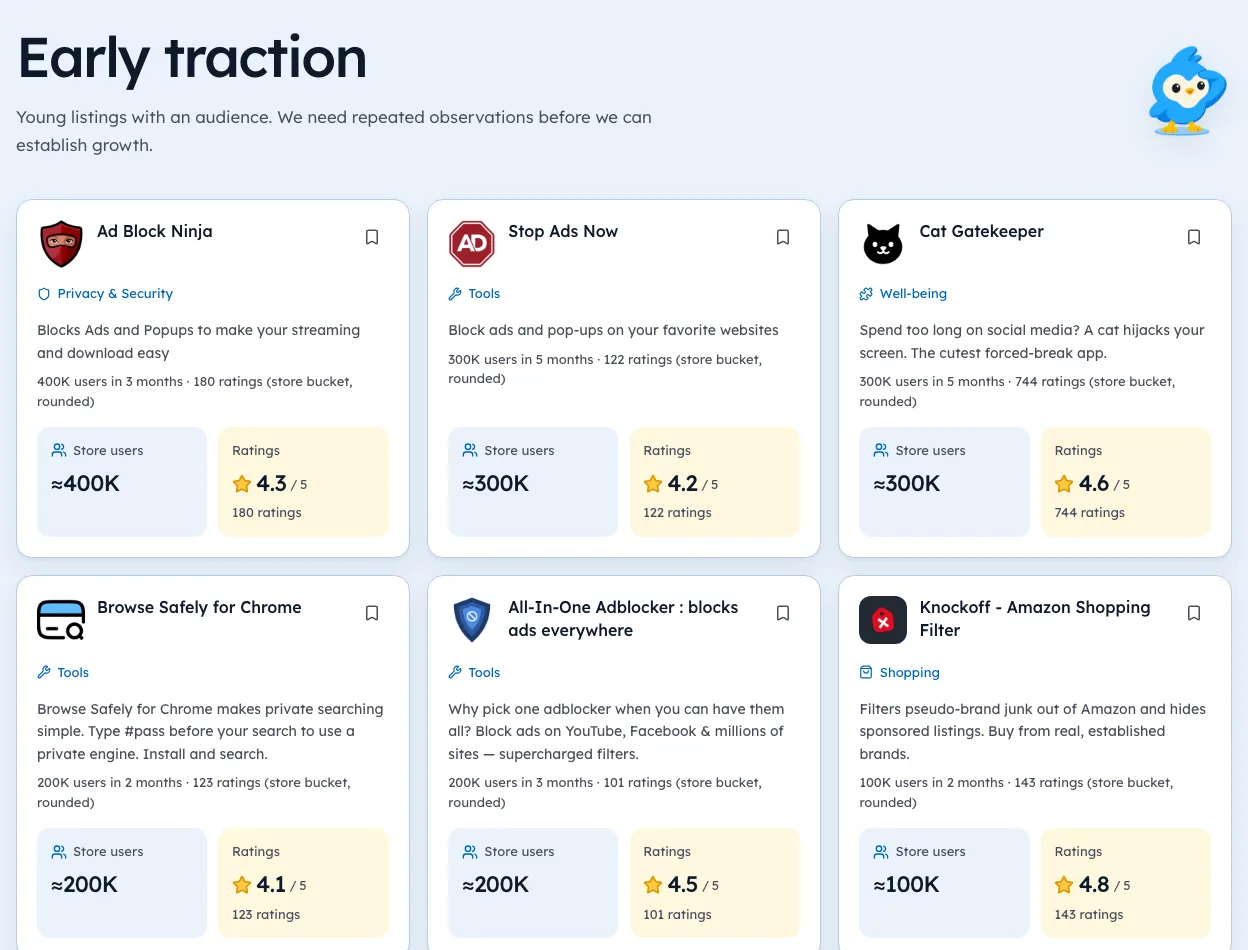
The screen recorders page has the dated counts if you want to check this yourself.
Test 3: could a giant make it a checkbox?
Browsers keep adding built-in tools: tab groups, reading mode, screenshots. Each one flattened a crowd of small extensions.
Test 4: does one platform own your fate?
Tools built on top of a single site, say a YouTube or Instagram helper, live at that site's mercy. One layout change breaks you. One policy change bans you.
That doesn't rule them out. It means you price the risk in and keep a second channel. The store adds its own risk, since every listing must follow Chrome's program policies.
Is a Chrome extension a business? What the store shows
Here's a small table of real listings as they stood on 3 October 2026, with our read of each:
| Extension | Users (store, rounded) | Rating | Our read |
|---|---|---|---|
| Momentum | 2,000,000 | 4.49 from 13,744 | Business: daily job, paid plan |
| Streak CRM for Gmail | 700,000 | 4.49 from 6,543 | Business: paid CRM plans on its site |
| Go Back With Backspace | 300,000 | 3.16 from 1,370 | Feature: one keystroke |
| Enable Right Click for Google Chrome | 500,000 | 3.50 from 842 | Feature: one switch |
The two "features" have big user counts and weak ratings. That's common for single-switch tools: lots of installs, little loyalty, and no obvious thing to charge for.
So which have you built?
Score yourself, one point per yes:
- [ ] People use it at least weekly.
- [ ] The paid part runs on your server.
- [ ] Chrome is unlikely to add it as a setting.
- [ ] You'd survive one site changing its layout.
Three or four points: build it like a business. One or two: it might be a great feature, or the front door to something bigger.
We're biased, but Ext Watch's Openings page is built for this check. It shows large extensions with weak ratings or long gaps between updates, so you can see whether a niche holds businesses or just switches.
Big paid examples are in the traits behind the most profitable Chrome extensions.
Run the four tests on your idea before you name it. A spoon can still lead to a restaurant.
Questions people ask
Can a Chrome extension be a full-time business?
Some are, usually when the extension fronts a paid web service. Standalone browser-only tools rarely get there.
Should you start with an extension or a web app?
Start where the job happens. If it happens inside other websites, an extension is the natural doorway.
Is a Chrome extension a good business idea?
It can be when the extension fronts a paid service on your server and does a job people repeat. A single-switch tool is usually a feature, not a business.
Where these numbers come from
- developer.chrome.comChrome Web Store program policiesAccessed 3 Oct 2026
Part of our guide: How to Make Money with Chrome Extensions: Proof First. More in Make money with extensions.

260 extensions tracked in Screen recorders. See them all.
Open niches with paying users and weak competition, checked against the store. Updated 3 Oct 2026 from our Chrome Web Store crawl