The short answer
The extensions that earn build a tool people open every working day, give away a useful free tier, and charge for the heavy use on your own website. The store itself doesn't take payments, so the money lives off the listing. Start by finding a busy niche where the leaders look tired.
- The Chrome Web Store has no built-in checkout, so paid extensions bill on their own sites.
- In our crawl of 61,820 extensions, only 346 had 1M+ users (2 to 3 Oct 2026).
- Half of those extensions had fewer than 857 users.
- Big, well-known paid tools often show no price anywhere in the listing.
Picture the store as a mall where none of the shops has a till. People walk in, try things, and pay somewhere else entirely. That one fact shapes all chrome extension earnings data you will read below.
Chrome extension earnings data: where the money moves
Google retired Chrome Web Store payments years ago (see TechRadar's 2020 report). So an extension that earns money sends you to a pricing page, a license key, or a payment provider like Stripe, Paddle, Gumroad or ExtensionPay.
That's why the listing is a poor place to judge income. Grammarly had 40M users in our 2 Oct crawl and sells paid plans on its own site. Its store listing and manifest gave our paid detector nothing to catch.
Our guide to making money with Chrome extensions turns this into a checking routine.
How big "big" really is
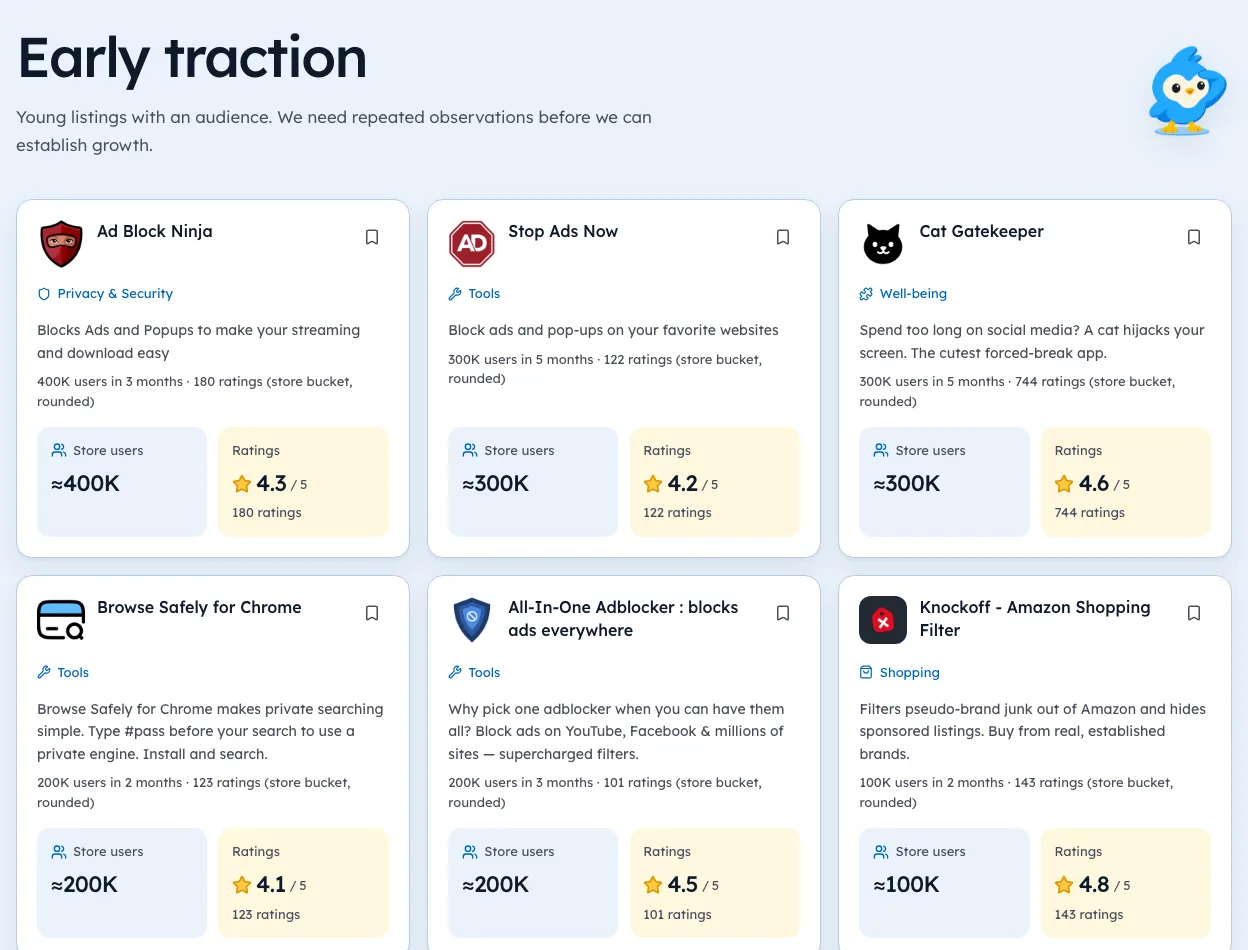
The user counts are lumpier than they look from the front page.
| Users (store count) | Extensions in our crawl |
|---|---|
| "Under 100" | 16,645 |
| "1,000 to 9,999" | 16,727 |
| "10,000 to 99,999" | 6,149 |
| "100,000 to 999,999" | 1,472 |
| "1,000,000 and up" | 346 |
Store user counts are rounded buckets, observed 2 Oct 2026.
So a tool at 10,000 users is already in the top eighth of what we crawled. You don't need a million users. Pick a niche where 10,000 users is a realistic goal.
For the current numbers, check the maps lead scrapers page.
Three ways extensions charge
- Freemium with a paid planThe free version is good enough to keep. Heavy users pay monthly. Loom (8M users on 2 Oct) and Streak CRM (700K) work this way, per their own pricing pages.
- CreditsYou pay for usage, not time. Keywords Everywhere (1M users) sells credit packs on its site.
- Companion to a paid productThe extension is free, the account behind it isn't. Password managers and SEO toolbars live here.
Each model hides from a quick look at the listing. A short summary of about 132 characters rarely names a price. Seven models, with live examples covers more.
Picking a niche that can pay
A niche can pay when three things line up. People open the tool daily. The job is tied to work or income. And the current leaders haven't shipped an update in a long while.
In our crawl, 2,859 extensions had 10,000+ users and no update in over a year (as of 3 Oct 2026). An old update date doesn't prove a tool is abandoned. It's a lead to check, nothing more.
Say you spot a Gmail helper at 50,000 users, last updated two years ago, rated 3.6. That's worth an afternoon.
Read its newest reviews on the store, check whether the publisher still sells it, and see if anyone has already shipped the fix. The top paid Chrome extensions show what charging looks like at scale.
Mistakes that cost the first year
- Charging before anyone uses it daily. A tool people open once a month rarely earns a subscription.
- Copying a giant. A niche with a 40M-user leader is a hard place to start.
- Trusting the rating alone. Grammarly had 43,131 ratings against 40M users on 2 Oct. That's about one rating per thousand users.
- Buying installs. It breaks the store's program policies and tends to end badly.
Tonight, open one tool you use daily and find its pricing page. That's the till the mall never had.
Questions people ask
Can you make money from a free Chrome extension?
Yes, through a paid tier, credits, or a paid account the extension connects to. Ads inside pages are tightly limited by store policy, so read it first.
How many users do you need to earn money?
There's no fixed number. A work tool with a few thousand daily users can earn more than a fun tool with a hundred thousand.
Does Google take a cut?
No store cut applies, since there's no store checkout. Your payment provider charges its own fees.
Where these numbers come from
- techradar.comTechRadar: Google ends paid Chrome extensionsAccessed 3 Oct 2026
- developer.chrome.comChrome Web Store program policiesAccessed 3 Oct 2026
Part of our guide: How to Make Money with Chrome Extensions: Proof First. More in Make money with extensions.


57 extensions tracked in Maps lead scrapers. See them all.
Open niches with paying users and weak competition, checked against the store. Updated 3 Oct 2026 from our Chrome Web Store crawl