The short answer
Don't do it. Google's program policies ban inflating installs, ratings or reviews by illegitimate means, and violations can lead to removal and account termination. Bought installs also leave a visible fingerprint: lots of users and almost no ratings. As of 3 Oct 2026, our crawl found 506 extensions with 10,000+ users and fewer than 5 ratings.
- Google's spam policy bans bought installs.
- Penalty: removal, possibly account termination.
- Bought users don't use the tool, so they don't rate or pay.
- 506 extensions in our 3 Oct 2026 crawl had 10K+ users and under 5 ratings.
If you buy Chrome extension installs, it's like hiring a crowd to stand outside your shop. It looks busy from across the street. Nobody inside buys anything.
The honest route to more users is covered in our Chrome Web Store SEO guide.
Should you buy Chrome extension installs? What the policy says
Google's program policies include a spam and abuse section that says developers must not inflate "product ratings, reviews, or install counts by illegitimate means, such as fraudulent or incentivized downloads, reviews and ratings."
That includes paying for reviews or giving rewards for them. Violations result in removal and can end the developer account. Our Chrome Web Store policy guide covers the rest.
The fingerprint bought installs leave
Real users rate. Not many, but some. In our crawl, a typical extension with 10,000+ users had a rating count around a quarter of a percent of its users.
| Users (store bucket) | Extensions | Median ratings per user |
|---|---|---|
| 1K+ | 16,727 | 0.50% |
| 10K+ | 6,149 | 0.27% |
| 100K+ | 1,472 | 0.18% |
| 1M+ | 346 | 0.08% |
Observed 3 Oct 2026, 65,655 extensions with store data. Users are rounded store buckets.
A listing with 10,000+ users and under 5 ratings is far outside that range. We found 506 of them. Some will have honest reasons, like a tool pushed by an employer. We don't accuse any listing, but the pattern is easy to spot for anyone looking, reviewers included. Our guide to Chrome Web Store ratings shows what normal looks like.
The Tools category page shows the dated counts behind this section.
Why it fails even if you're never caught
- Bought users don't use it, so your uninstall rate climbs. Google's docs say rankings look at downloads versus uninstalls.
- They never pay, so revenue stays where it was.
- Your own numbers lie to you. You can't tell what's working.
A thousand real users teach you more than fifty thousand fake ones.
How install sellers pitch it
Sellers rarely say "fake". The pitch usually sounds like a growth service. Knowing the phrases helps you spot it.
| What the seller says | What it usually means |
|---|---|
| "Kickstart your ranking" | Installs from devices that never use the tool |
| "Real users from our network" | People paid or rewarded to install |
| "Guaranteed 5-star reviews" | Incentivised or written reviews |
| "Safe, undetectable" | No one can promise this |
| "Pay per 1,000 installs" | Volume with no intent behind it |
Any offer that guarantees a number of installs or reviews falls under the policy. Real marketing can't guarantee installs, because real people choose.
What Google says it looks at
Google doesn't publish how it detects abuse. It does publish what feeds ranking. Its discovery docs mention ratings, usage and the balance between installs and uninstalls.
Bought installs push that balance the wrong way. The devices install, never use the tool, and many uninstall. So even before any penalty, the purchase works against the very ranking it was meant to lift.
The rating gap is the other tell. In our 3 Oct 2026 crawl, 878 extensions had 1,000 or more users and no ratings at all. Another 165 had 100,000 or more users and fewer than 20 ratings. Some have honest reasons, such as company-installed tools that staff never chose. But a reviewer looking at your listing sees the same numbers anyone can.
Honest channels, by budget
Whatever you'd spend on installs buys something better. Here's how the same money stretches across real channels.
| Budget | Where to spend it |
|---|---|
| Nothing but time | Answer questions in two communities each week |
| A small amount | Better screenshots and a clear icon |
| A modest amount | A short tutorial video for the job your tool does |
| A larger amount | Search ads on the exact problem phrase, to your listing |
Ads can be fine. The difference is that a person searching for the problem clicks, reads your listing and chooses to install. Those users rate, keep the tool and sometimes pay. Our guide to Chrome extension marketing lays out a plan from zero.
If you already bought installs
Some founders try it early, then regret it. If that's you, the best path is to stop and let real use take over.
- Stop any running campaignsright away.
- Don't try to hide itby buying reviews to match the users.
- Focus on real usersfor the next few months, so honest ratings outnumber the gap.
- Read the policy sectionagain so you know what's at stake.
If Google contacts you about a violation, respond through the dashboard and be straight about what happened. Hiding it rarely helps.
Checking a rival's numbers
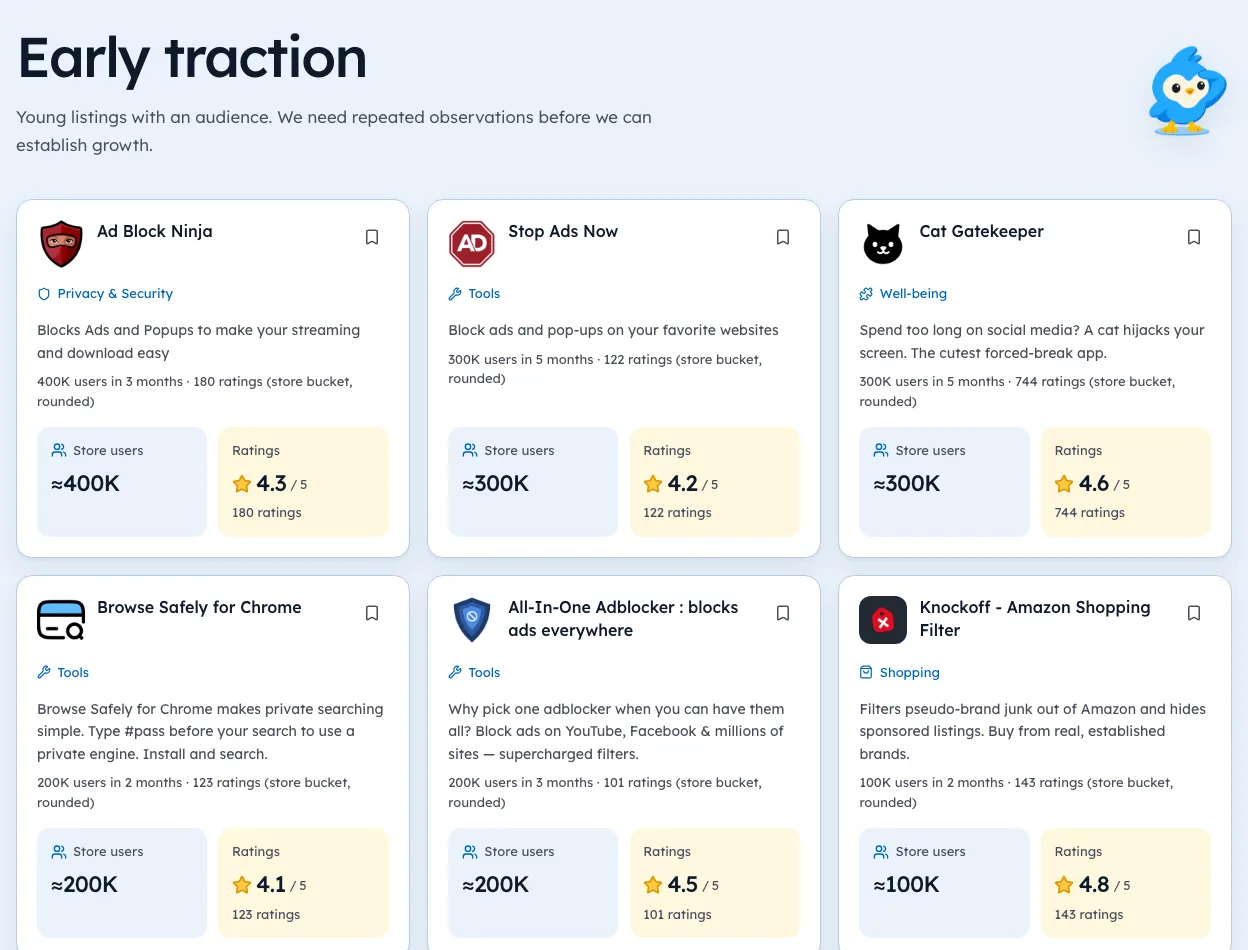
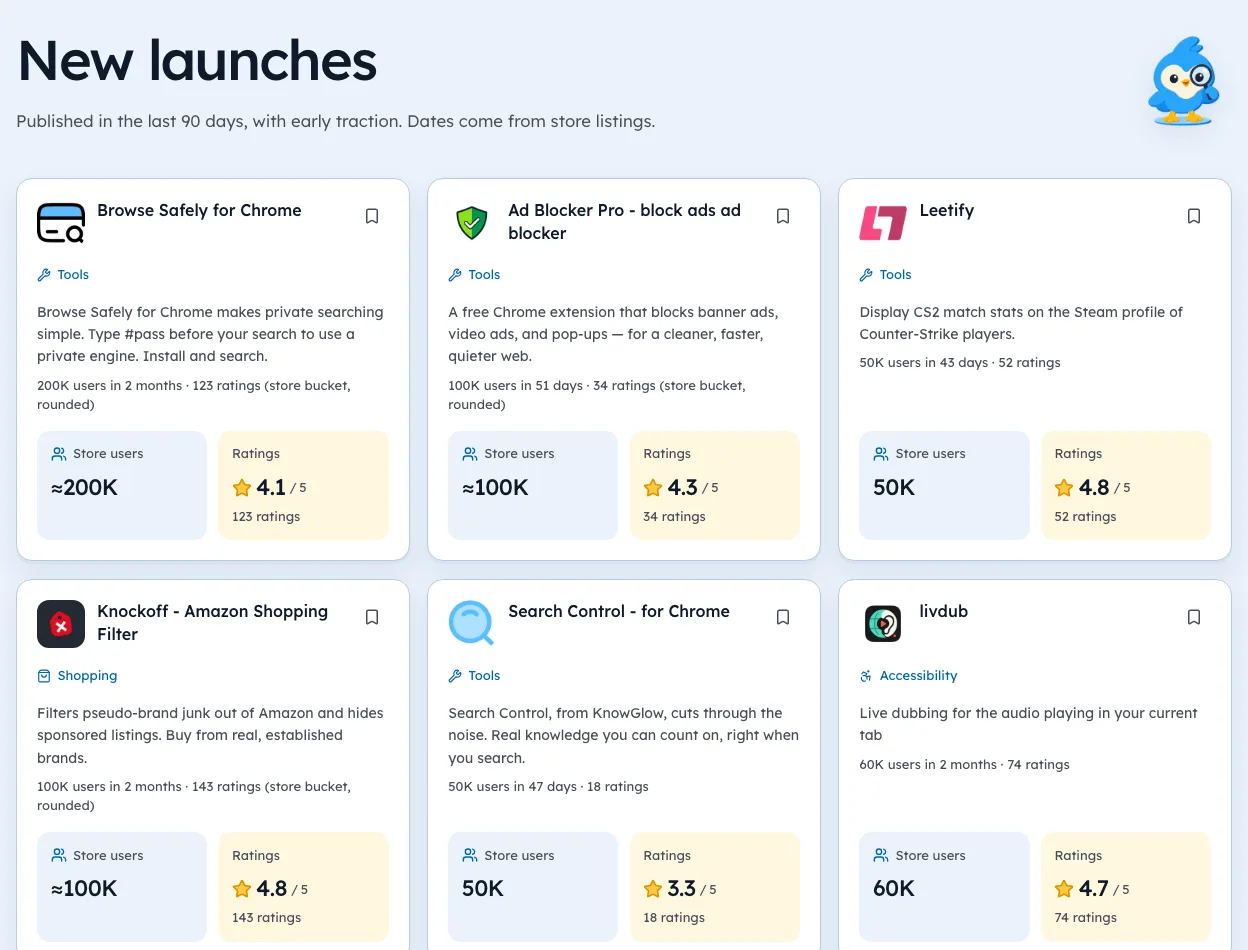
You may suspect a competitor bought their way up. Before you act on that, look at the full picture. Our New launches page shows young listings with their user bucket and rating count side by side, which makes an odd gap easy to see. A gap alone isn't proof, so treat it as a reason to look closer, not a reason to copy them.
What real early growth looks like
If you're tempted to buy installs because growth feels slow, it helps to see what slow but honest looks like. In our 3 Oct 2026 crawl, 11,601 extensions had been published in the previous 30 days. Their median user count was 4. Only 41 had reached 1,000 users.
| Stage | What's normal |
|---|---|
| First month | Single or double-digit users for most listings |
| First 1,000 users | A clear listing plus one working channel |
| First ratings | A handful, from early fans |
| First 10,000 users | Months of steady work, for the few who get there |
Slow is the norm. A listing that jumps to tens of thousands in week one with no ratings stands out, to users and to reviewers.
A better use of the first month
Instead of buying installs, spend the first month on things that compound.
- Talk to your first ten usersby email. Ask what almost stopped them installing.
- Fix the top confusionin the first-run screen.
- Rewrite your first lineusing the words those users chose.
- Answer three community questionsa week about the problem you solve.
These cost time, not money, and every one of them makes later users more likely to stay and rate. Our New launches page shows what young listings with honest early audiences look like.
What to do instead
- Fix the first line of your listing.
- Answer five real questions in a community where your users gather.
- Write one page that solves the problem, with your tool as one option.
We're biased, since we build Ext Watch. Our extension pages flag high users with very few ratings, so you can check whether a rival's numbers hold up before you copy their plan.
Send the hired crowd home. Open the door properly.
Questions people ask
Is it legal to buy Chrome extension installs?
It breaks Google's store policy, which can get the listing removed. Ask a lawyer about anything beyond that.
Can Google detect fake installs?
Google doesn't say how. The ratings gap above is visible to anyone.
Do bought installs hurt your Chrome Web Store ranking?
They can. Bought users don't use the tool, so uninstalls climb, and Google's discovery docs say rankings look at downloads versus uninstalls.
What about buying reviews instead of installs?
Same rule. Google's spam policy names fraudulent or incentivised reviews and ratings alongside installs.
Is running ads the same as buying installs?
No. Paying for ads that send real people to your listing is normal marketing. Paying for installs from people who never chose your tool is what the policy bans.
What changed
- Refreshed the ratings-per-user table and fake-install counts to our 3 Oct 2026 crawl, and added sections on how sellers pitch installs, what Google looks at, and honest channels by budget.
Where these numbers come from
- developer.chrome.comChrome Web Store program policiesAccessed 3 Oct 2026
- developer.chrome.comChrome Web Store discovery docsAccessed 3 Oct 2026
Part of our guide: Chrome Web Store SEO: titles, descriptions, screenshots. More in Growth and ranking.


4,821 new extensions in the last 30 days in Tools. See them all.
Extensions gaining users fastest, and what they changed. Updated 3 Oct 2026 from our Chrome Web Store crawl