
The short answer
A good micro SaaS idea finder shows evidence of demand, such as users, ratings, searches or complaints, with dates attached. Idea lists and generators give inspiration but prove nothing. Store data, review mining and search tools each prove one thing; combine at least two before you build.
- Idea lists inspire; they don't prove demand.
- Store data shows users and ratings, not revenue.
- Review mining shows pain in users' own words.
- Search tools show what people type, not what they pay for.
There are six kinds of micro SaaS idea finder, from AI generators to store analytics. Each one answers a different question. The trouble starts when you treat one answer as the whole picture.
Here's what each type proves, and what it quietly doesn't. If the term is new, what is micro SaaS covers the basics.
The six types of micro SaaS idea finder side by side
| Finder type | What it proves | What it hides |
|---|---|---|
| Idea lists and newsletters | Someone found it interesting | Whether anyone wants it |
| AI idea generators | Nothing yet | Everything about demand |
| Search and autocomplete tools | People type the phrase | How many will pay |
| Forum and Reddit mining | Real pain in real words | How widespread it is |
| Store data (apps, extensions) | Users and ratings exist | Revenue and pricing |
| Review mining | What current users hate | Whether they'd switch |
No single row is enough. The useful pairs are store data plus review mining, or search data plus forum mining.
Idea lists and generators
These are the most fun and the least useful. A list of ideas tells you what a writer thought might work. A generator tells you what a model thinks sounds plausible.
Use them to spark angles, then go check demand somewhere else. How to find micro SaaS ideas shows the full process.
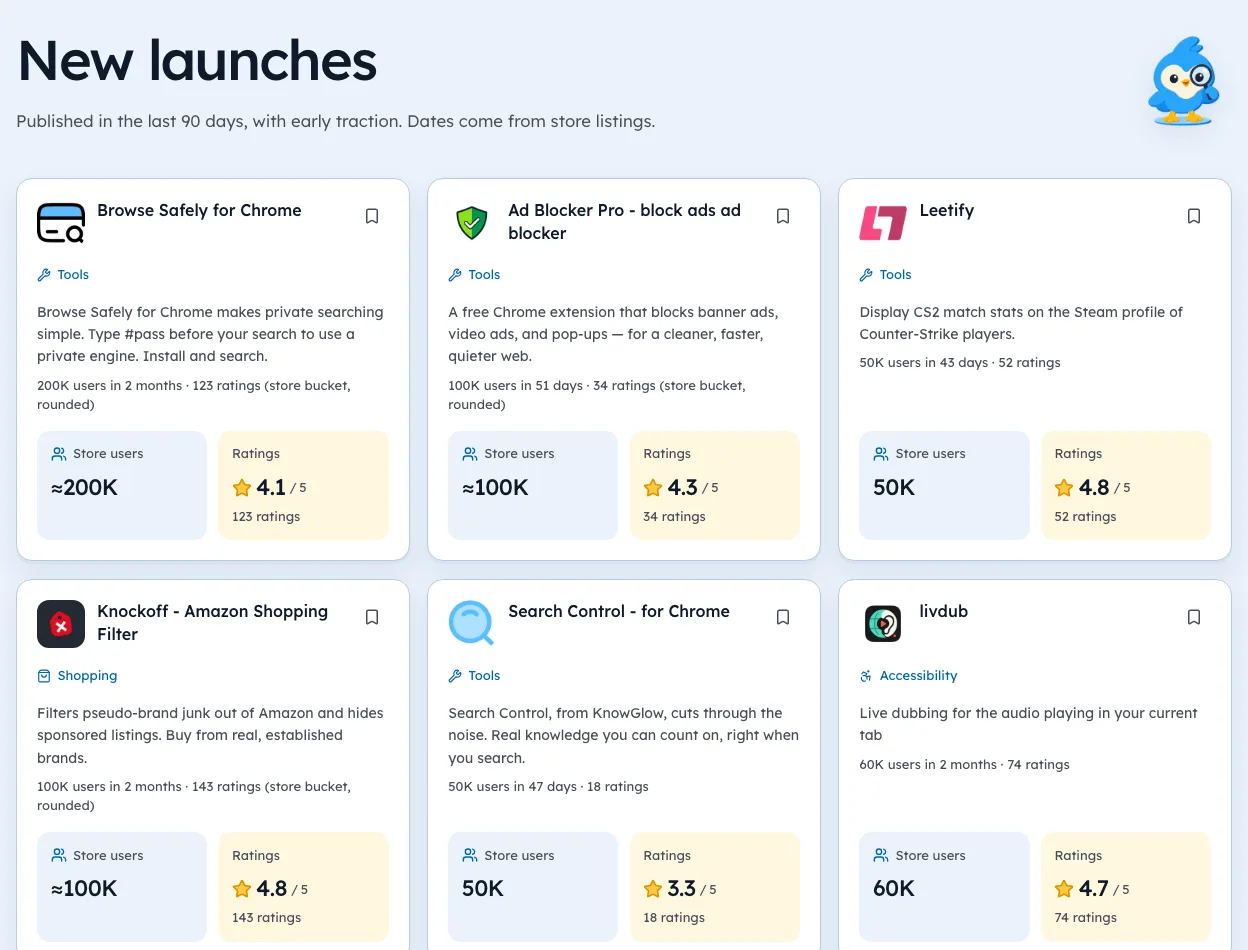
Our web scrapers page keeps the same counts, each with the day we saw it.
Search tools
Autocomplete and keyword tools show what people actually type. Google Trends shows relative interest over time.
Forums and Reddit
Forums give you pain in plain language. Someone writing "we lose an hour every Monday doing X" is gold.
The limit is scale. A loud thread can be five people.
Store data
Stores like the Chrome Web Store show users and ratings for every listing. That's real evidence that people installed and used a thing.
In our crawl, 61,820 extensions had stored data, observed 2 Oct 2026, covering about 21% of store sitemap IDs.
Store data proves usage, never revenue. A listing with no price text can still be a paid product sold on the maker's site.
We're biased: Ext Watch is a store-data finder. That's why we're blunt about its limit. It shows where users are, then you check pricing yourself.
Pair that count with a pain source before you build. For fresh angles, see micro SaaS ideas to copy.
Review mining
Reviews tell you what users want fixed. Sort by newest, read ten, and note complaints that repeat.
Picking your mix
- Start with one demand source: store data or search data.
- Add one pain source: reviews or forums.
- Check pricing on rivals' own sites.
- Only then look at idea lists for fresh angles.
One small step
Open the Chrome Web Store, search your niche, and pick the most popular tool with the lowest stars. Read its newest ten reviews.
That's an idea finder that costs nothing.
Questions people ask
What is the best micro SaaS idea finder?
The one that shows evidence you can check. Combine a demand source, like store data, with a pain source, like reviews.
Are AI idea generators useful?
They're fine for brainstorming angles. Their ideas carry no demand evidence, so treat them as a starting list.
Can you find micro SaaS ideas for free?
Yes. Store pages, public reviews, forums and autocomplete are free. Paid tools mostly save time.
Where these numbers come from
- trends.google.comGoogle TrendsAccessed 3 Oct 2026
- chromewebstore.google.comChrome Web StoreAccessed 3 Oct 2026
Part of our guide: What Is Micro SaaS? A Plain Guide With Real Examples. More in Tools and comparisons.


541 extensions tracked in Web scrapers. See them all.
Watch any extension for user, rating, version and owner changes. Updated 3 Oct 2026 from our Chrome Web Store crawl