
The short answer
Growth needs at least two readings of the same listing, weeks apart. One snapshot shows size, never speed. Our own history began on 2 Oct 2026, so we can't yet name the extensions that climbed. What we can show is where young listings stand today and what a real growth claim needs.
- One snapshot can't show growth. It shows size.
- Our tracking started 2 Oct 2026.
- As of 3 Oct 2026, 11,601 crawled extensions were first published in the last 30 days, with a median of 4 users.
- User counts are rounded buckets, so rating counts move first.
Judging Chrome extension growth from one snapshot is like guessing a child's height next year from one photo. You can see how tall they are. You can't see how fast they're going.
Why we didn't write "what the climbers did"
This post was planned as a list of extensions that climbed fastest. When we checked our data, we had one day of history. Any "climber" list would have been users divided by age, which is a guess dressed as a trend.
So we're saying it plainly. We'll publish climbers once we've measured them. For what drives visibility meanwhile, see Chrome Web Store SEO.
Many "fastest growing" lists online use the same users-divided-by-age shortcut. A beta channel or a re-listed clone can top that kind of list.
What one snapshot does show
| What we can see in a snapshot | What it tells you | What it can't tell you |
|---|---|---|
| Users bucket | Rough size | Whether it's growing |
| Age since first published | How young it is | How it got its users |
| Rating count | How many people rated | Recent momentum |
| Last update date | Whether someone's shipping | Whether users care |
| Publisher's other tools | Existing audience | Marketing spend |
As of 3 Oct 2026, 11,601 extensions in our crawl were first published in the last 30 days. Young doesn't mean growing. Exact install history stays with the publisher, in the developer dashboard.
The Tools category page lists the same extensions with users and ratings.
What real Chrome extension growth needs
- Two or more readings of the same listing, at least 7 to 14 days apart.
- A change in rating count (see how store ratings work), since store user counts are rounded buckets like "10,000+".
- Enough new ratings that the change isn't noise. We use 10 as a floor.
- The dates of both readings, shown next to the number. Written reviews add context, as our reviews guide explains.
Ask any "fastest growing" list for its two dates. If it can't give them, it measured size.
What young listings really look like
The one thing a single snapshot can show well is the spread. Here's every extension in our crawl first published between 3 Sep and 3 Oct 2026.
| Measure | Value |
|---|---|
| Extensions first published in 30 days | 11,601 |
| Median users | 4 |
| With 1,000 or more users | 41 |
That's the base rate any launch is up against. Most new listings sit near zero for their first month. Only 41 of 11,601 crossed 1,000 users in that window.
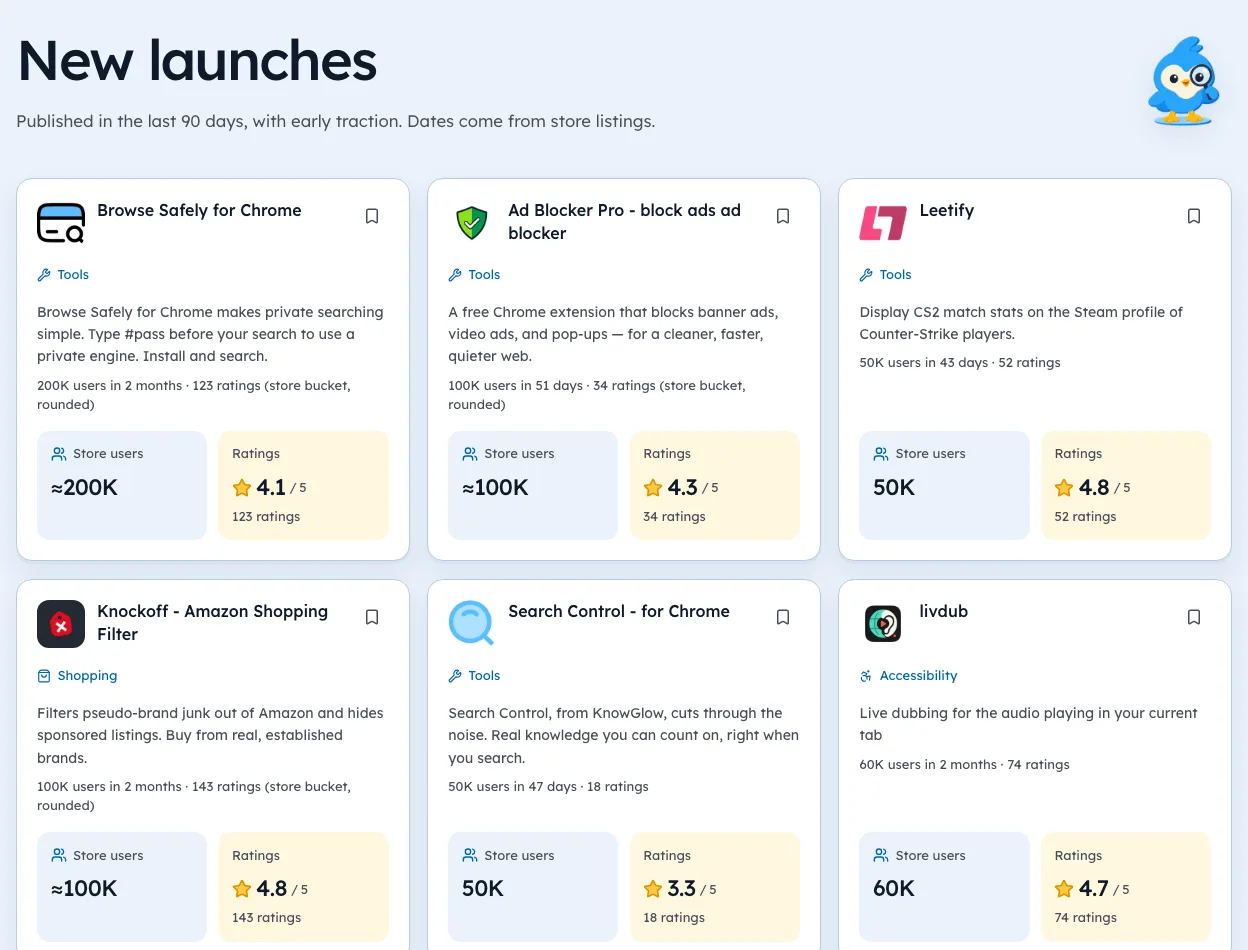
A few young listings did stand out on our New launches view that day. Knockoff, an Amazon shopping filter, showed 100,000 users and a 4.76 rating from 143 ratings at 88 days old. livdub showed 60,000 users and 74 ratings at 73 days. These are sizes, not speeds. We'll know whether they're climbing after a second reading.
All figures from Ext Watch's crawl, observed 3 Oct 2026. Store user counts are rounded buckets, like "100,000+".
Fake-growth tells
A big number on a young listing isn't always earned. Before treating one as a model to copy, check for these.
- A high user bucket with very few ratings. Real users leave ratings slowly but steadily.
- A big publisher behind it. A new tool from a company with millions of users elsewhere isn't a growth story, it's a launch to an existing audience.
- A moved or re-listed item. Some publishers move users from an old listing to a new one.
- A burst of near-identical five-star reviews in one week.
None of these prove anything alone. Together they mean the number isn't a fair comparison for an indie launch. Our guide to bought installs covers why that path backfires.
A tracking sheet you can copy
You don't need a tool to measure growth on a few listings. You need the same three readings, taken on a schedule.
| Date | Extension | Users bucket | Rating count | Rating | Version |
|---|---|---|---|---|---|
Take readings every 7 days for at least a month. Then look at the rating count column. If it climbs steadily, users are arriving. If it's flat while the user bucket jumps, ask why.
What tends to drive growth (from the outside)
We can't yet measure who grew, but we can list what tends to sit behind listings that got big. These are patterns from reading listings, not measured causes.
- A job people search for in plain words, with that phrase in the name.
- Regular, small updates. About a third of all extensions in our crawl shipped an update in the 30 days before 3 Oct 2026.
- A healthy rating count that keeps going up week after week.
- A clear first screenshot showing the result.
- One channel that keeps sending people, like a community, a search page or a partner.
Our guide to Chrome extension marketing turns these into a weekly routine.
Growth by category: size today
We can't show speed yet, but we can show where the big audiences already are. These counts come from our crawl on 3 Oct 2026.
| Category | Extensions | With 10k+ users |
|---|---|---|
| Tools | 22,452 | 1,956 |
| Workflow & Planning | 13,868 | 2,542 |
| Developer Tools | 6,306 | 778 |
| Accessibility | 2,449 | 463 |
| Privacy & Security | 1,409 | 264 |
Workflow & Planning has fewer listings than Tools but more large ones. That's a hint about where users stick, not proof of growth. Once our readings build up, this table will gain a column for change over time. You can browse these on our categories pages.
What we'll publish, and when
To keep this honest, here's the plan for our own growth numbers.
- From 16 Oct 2026first 14-day readings of rating count changes.
- From early November 202630-day readings, which are steadier.
- After thatmonthly updates to this post with the listings that moved most, each with both dates.
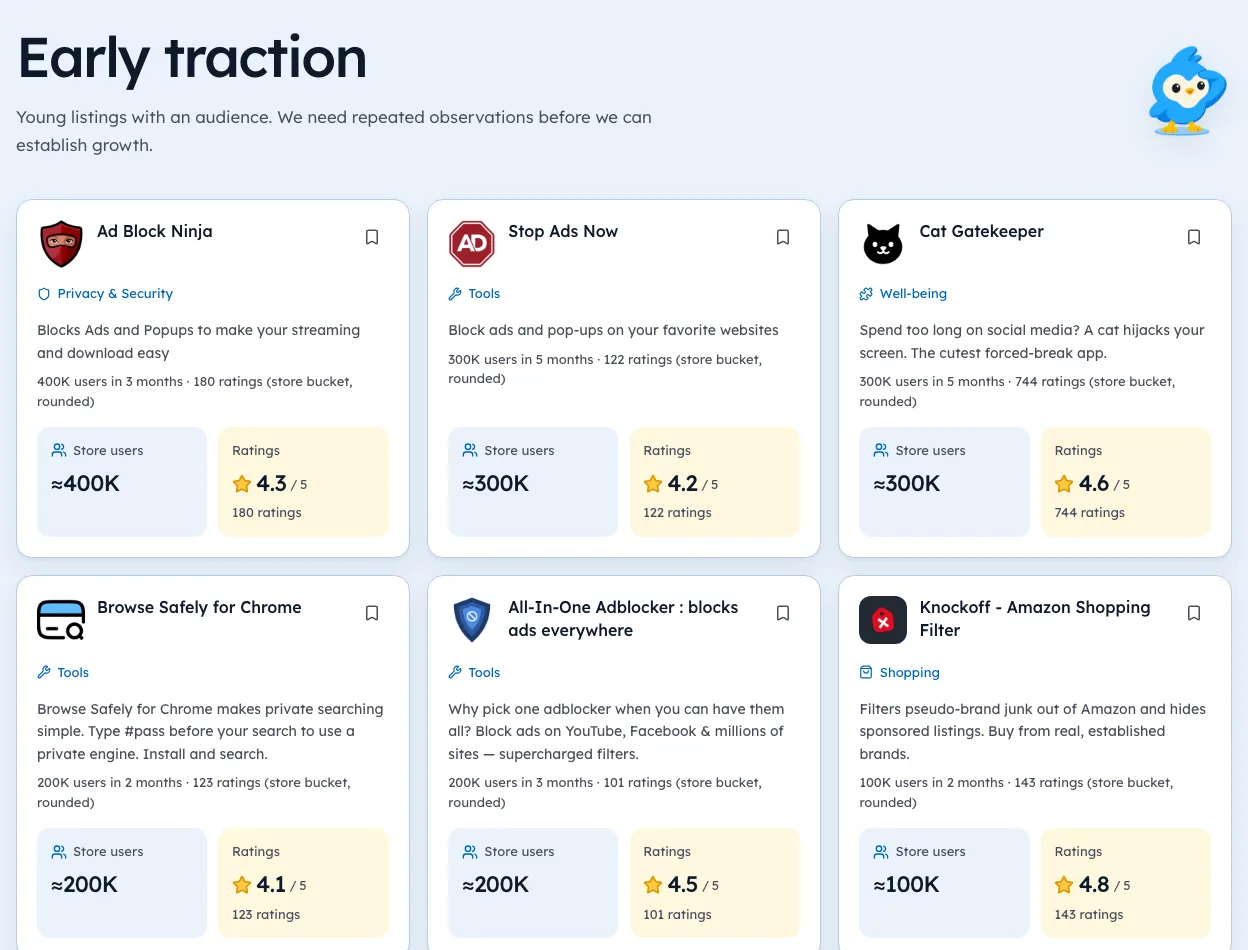
Until then, our Early traction page shows young listings that already have an audience, without calling it growth.
Growth questions we can answer today
Even without trend lines, some useful questions have answers now.
| Question | Answer on 3 Oct 2026 |
|---|---|
| How many extensions are over 10,000 users? | 7,967 of 65,655 |
| How many are over 1 million? | 346 |
| How many young listings crossed 1,000 users? | 41 of 11,601 in their first 30 days |
| How many big listings have almost no ratings? | 506 with 10,000+ users and under 5 ratings |
These give you a sense of the climb before anyone measures speed. Getting to 1,000 users in the first month is rare. Getting to 10,000 puts you in the top eighth of listings with a count.
For builders: setting your own growth goals
Without store-wide growth data, set goals from your own numbers.
- Pick one number, usually rating count or weekly active users.
- Take a baselinetoday.
- Set a modest monthly target, then adjust after three months.
- Tie each month's workto one lever, like the listing or a channel.
Your own trend line, with honest dates, is worth more than any average from another niche. Our guide to store analytics shows where to find your numbers.
When we'll have climbers
Our first 14-day growth readings land around 16 Oct 2026, and 30-day readings in early November. We're biased, since we build Ext Watch, but we'd rather show an empty list than a fake one.
Take a second photo before you guess the height.
Questions people ask
How do Chrome extensions grow?
We'll answer with measured data once our history is long enough. As of 3 Oct 2026 we can show size and age only.
Can I see install history for an extension?
The store doesn't publish it. Trackers record their own snapshots from their own start date.
How fast should a new Chrome extension grow?
We can't say yet. Our history began on 2 Oct 2026, and a fair reading needs 14 to 30 days. Be wary of lists that simply divide users by age.
What counts as fast growth for a Chrome extension?
We'll set that bar from measured data. Until then, compare rating count changes between listings of a similar age in the same niche.
Why do some new extensions have huge user counts?
Some come from big publishers with existing audiences, some are moved listings, and a few have bought installs. Check the publisher and the rating count.
What changed
- Refreshed counts to our 3 Oct 2026 crawl, added the real spread of young listings, a guide to fake-growth tells and a tracking sheet you can copy.
Part of our guide: Chrome Web Store SEO: titles, descriptions, screenshots. More in Growth and ranking.


4,821 new extensions in the last 30 days in Tools. See them all.
Extensions gaining users fastest, and what they changed. Updated 3 Oct 2026 from our Chrome Web Store crawl